
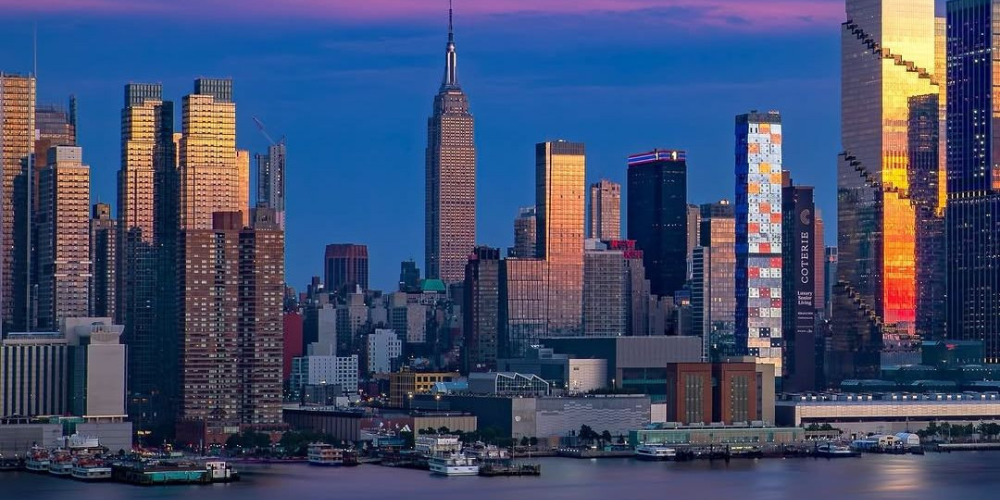
How New York City Reflects the Story of America
Few cities spark as much admiration and criticism as New York City. For centuries, it has stood at the center of debates about wealth, immigration, culture, identity, and opportunity. Some have viewed it as the ultimate symbol of American ambition, while others have argued that it is too large, too diverse, and too connected to the rest of the world to represent the nation.
These contrasting opinions have existed since the country’s earliest years.
Historian Mike Wallace devoted decades to explaining why New York inspires such divided reactions. His extensive historical work revealed that the city’s contradictions are not exceptions to the American experience.
Instead, they reflect many of the same social, economic, and political forces that have shaped the United States from the beginning.
Mike Wallace’s Landmark Historical Work

wikipedia.org | Acclaimed historian Mike Wallace has passed away, leaving behind the definitive history of New York City.
Mike Wallace, one of America’s most respected historians, passed away recently after leaving behind one of the most detailed studies ever written about New York City. Alongside historian Edwin G. Burrows, who died in 2018, Wallace began an ambitious effort in 1976 to document the city’s complete history.
Their collaboration produced the Pulitzer Prize-winning “Gotham: A History of New York City to 1898” in 1999. Wallace later expanded the series with “Greater Gotham” in 2017 and “Gotham at War” in 2025, bringing New York City’s story through the end of World War II in 1945.
Rather than presenting history as a simple timeline, these books explain how the city’s people, neighborhoods, businesses, and institutions developed together. Each volume combines historical detail with engaging storytelling, making complex events easier to understand without sacrificing accuracy.
A City Constantly Reinventing Itself
One of the central ideas explored by Wallace and Burrows is that understanding New York requires looking at its continuous transformation. The city changed rapidly over several centuries. It began as a small trading settlement during the seventeenth century, expanded into a busy colonial seaport in the eighteenth century, and later became the country’s leading center for finance, manufacturing, commerce, and culture during the nineteenth century.
Because each generation experienced a different version of New York, observers often struggled to describe what they were seeing. The city’s growth happened so quickly that every decade introduced new neighborhoods, industries, and communities.
As a result, New York rarely fits into a single definition. Instead, it reflected America’s constant economic growth, population shifts, and changing social values.
Broadway as a Window Into Global Commerce
The movement of people and goods through New York left a lasting impression on writers and travelers. Wallace and Burrows explain that many observers relied on comparisons with oceans, rivers, and tides because the city’s activity seemed endless.
Henry Theodore Tuckerman captured this feeling while describing a walk along Broadway in “The Atlantic” in 1866. He listed an extraordinary collection of products arriving from across the world, including “Persian carpets, Lyons silks, Genoa velvets, ribbons from Coventry and laces from Brussels, the furs of the Northwest, glass of Bohemia, ware of China, nuts from Brazil, silver of Nevada mines, Sicily lemons, Turkey figs,” along with countless other imported goods.
This remarkable variety reflected more than commercial success. It showed how New York had become one of the world’s busiest trading centers, where international commerce and cultural exchange shaped everyday life.
Wealth, Poverty, and Social Divides
Economic opportunity also created striking inequalities throughout the city. Wallace and Burrows describe New York as a place where wealthy elites and struggling immigrant communities lived within close proximity while experiencing completely different realities.
The authors referred to the city’s “stark, indeed shocking, contrast between the new social classes: a monied aristocracy of debauched nouveaux riches and a threatening mass of degenerate immigrants.”

Instagram | nyc | Economic opportunity split New York into parallel worlds of elite wealth and immigrant struggle.
These conditions influenced how visitors judged both New York and the nation itself. Some viewed the city’s prosperity as proof of American success. Others believed its growing inequality exposed serious social problems.
For example, rural physician Joel Ross criticized New York in 1851 by describing its “trials, losses, frowns, failures, pestilence, poverty, and hypocrisy.” He warned that the city was “to dwellers in the country, very like what white lights at night are to flies—brilliant and attractive, but certain ruin.”
At the same time, supporters praised New York’s achievements. One admirer described it in 1857 as “the locomotive of these United States,” recognizing its economic influence across the country. Another historian celebrated its cultural diversity in 1859 by writing, “a mixture of many materials makes the best mortar.”
These opposing viewpoints reveal how New York often became a symbol for larger national debates.
Understanding America’s Biggest Questions
The “Gotham” series places these developments within their historical context. Rather than presenting New York’s challenges as isolated events, Mike Wallace and Edwin G. Burrows explain the economic, political, and social forces that shaped the city.
The crowded commercial streets of Broadway become easier to understand when viewed alongside New York’s rapid economic expansion. Similarly, the stark contrast between luxury neighborhoods and the Five Points slums reflects broader patterns of immigration, industrialization, and urban growth.
Their research also explains why New York became a symbol of key aspects of American life. Wall Street represents finance, Ellis Island symbolizes immigration, and Broadway stands for entertainment. Together, these landmarks illustrate how the city’s history mirrors the broader story of the United States.
Through the work of Mike Wallace and Edwin G. Burrows, New York emerges as a place where America’s growth, challenges, and evolving identity can be understood. Their research demonstrates how the city’s past continues to offer valuable insight into the forces that have shaped the nation.
More in Culture
-
`
 Why Elon Musk Was Left Out of Trump’s “Tech Bro” Council
President Donald Trump recently announced a new advisory council focused on science and technology, bringing together some of the most influential...
April 8, 2026 -
`
 What Is Workplace Culture? Understanding Its Meaning & Importance
“Workplace culture” is a term frequently seen in job postings, company websites, and professional conversations. Despite its prevalence, it’s often misunderstood...
April 1, 2026 -
`
 Why Surging Oil Prices Won’t Spark a U.S. Inflation Nightmare
Rising oil prices have rattled financial markets and raised fresh concerns about inflation across the United States. Since the start of...
March 25, 2026 -
`
 This 112-Acre Florida Island Inspired Jimmy Buffett’s ‘Cheeseburger in Paradise’
Off the southwest coast of Florida sits a small island that feels refreshingly untouched by modern development. Cabbage Key may be...
March 16, 2026 -
`
 The Group Chat Rules Nobody Talks About (But You Should Follow)
Group chats have quietly reshaped daily communication. Plans for dinner, updates about a child’s birthday, collaboration on a work project, and...
March 9, 2026 -
`
 How the Bay Area Skate Culture Started
For those who grew up in the 1980s, Friday nights often meant the roller rink: dimmed lights, pulsing music, and skaters...
March 5, 2026 -
`
 $2 Million Raised in 2 Days for James Van Der Beek’s Family on GoFundMe
The passing of James Van Der Beek at 48 prompted an immediate surge of public support. A GoFundMe campaign set up...
February 25, 2026 -
`
 How to Plan a Hawaii Vacation Without Stress or Overspending
Planning a trip to Hawaii can feel overwhelming, but it doesn’t have to be complicated. With the right approach, travelers can...
February 19, 2026 -
`
 $42 Million Tahoe Estate Finally Bought by Tech Mogul After 8 Years on the Market
A long-standing lakefront listing on the Nevada side of North Lake Tahoe has finally changed hands, drawing attention across real estate...
February 12, 2026
More From Todaysnyc
-
 Mike Brown Spotted With Wife on Italian Vacation After Knicks Win
Mike Brown is enjoying a quieter stretch after a landmark first season with the New York Knicks. The coach was recently...
Luxury & Life StyleSeptember 1, 2026 -
 Why NYC’s Subway Heat Is a Problem
New York City subway stations can become painfully hot during the summer. Now, city and state officials are studying whether that...
TechAugust 25, 2026 -
 Jason Sudeikis’ Mail Leads NYC Woman to “Ted Lasso” Premiere Meeting
A surprising piece of mail turned into an unexpected Hollywood connection for a New York City resident. Mental health counselor and...
CultureAugust 18, 2026 -
 Mamdani’s Red Tape Cuts Bring New Support for NYC’s Local Businesses
New York City’s small business owners are facing a major change in how they handle permits, fees, and government regulations. Mayor...
BusinessAugust 11, 2026 -
 Chelsea Handler’s Family Vacation Rules Spark Celebrity Reactions
Family vacations often create lasting memories, but they can also test patience when expectations are unclear. Comedian Chelsea Handler recently sparked...
Luxury & Life StyleAugust 4, 2026
You must be logged in to post a comment Login