
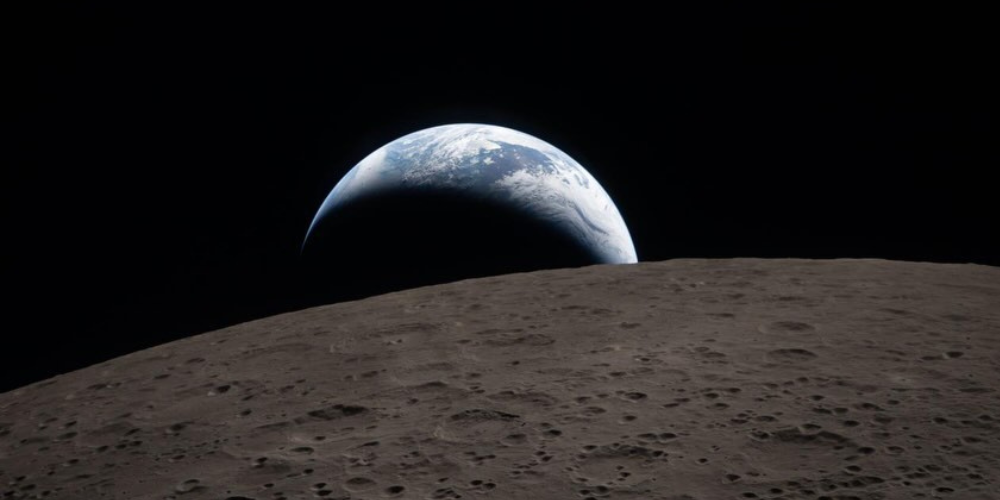
Humans May Soon Live and Work on the Moon, Says Space Tech CEO
The idea of humans living beyond Earth is moving from speculation to near-term planning.
According to space industry leaders, the Moon may soon host not just visitors, but a working population. New developments, rising investments, and bold timelines suggest that daily life on the lunar surface could begin within the next decade.
Dylan Taylor, chairman and CEO of Voyager Technologies, shared a clear vision during a panel at CNBC’s CONVERGE LIVE event in Singapore. He stated, “We’ll have humans on the moon by the end of the 2020s, and we’ll have some lunar base — it’ll probably be an inflatable habitat with some life support.”
His comments point to early infrastructure that prioritizes function over permanence, setting the stage for future expansion.
A Timeline That Feels Closer

Instagram | dylantaylorspace | Voyager CEO Dylan Taylor predicts moon landings and inflatable lunar bases by 2030.
Taylor offered a striking picture of the near future. By the early 2030s, he suggested, lunar activity will be visible from Earth itself. “You’ll be able to sit on your porch in upstate New York and look at the moon, and there’ll be lights on the moon,” he said. “Because there’ll be people living and working on the moon.”
This projection aligns with broader industry momentum. The United States continues to lead commercial space development, according to Dave Cavossa, president of the Commercial Space Federation. Financial analysts are also paying close attention. A Deutsche Bank note from February described the emerging “moon economy” as a sector on the edge of major expansion.
Private companies are playing a central role. Elon Musk’s SpaceX is reportedly preparing for a highly anticipated IPO while focusing on building what Musk described as a “self-growing city on the Moon,” potentially within a decade.
At the same time, Blue Origin announced in January that it would pause suborbital tourism flights to concentrate on establishing a long-term human presence on the lunar surface.
Government Support and Investment
Public funding is adding momentum to these ambitions.
On April 3, U.S. President Donald Trump proposed increasing defense spending to $1.5 trillion. Later in the month, the U.S. Air Force and Space Force requested over $300 billion for the 2027 fiscal year. This level of investment signals strong government backing for space-related infrastructure and research.
Voyager itself is advancing key projects. The company went public in June and is widely recognized for its Starlab initiative, designed to replace the International Space Station, which is expected to retire by 2030.
This shift highlights how space infrastructure is evolving from temporary missions to long-term operations.
Growing Interest Beyond Earth

Instagram | singapore_edb | Trudeau praised Canada’s historic role in the big deal Artemis II lunar mission.
Global interest in lunar missions continues to rise. Former Canadian Prime Minister Justin Trudeau described the Artemis II mission—which included the first Canadian to fly around the Moon—as a “big, big deal.”
Speaking at the same event, he noted that such missions inspire cooperation and technical excellence. “As we start landing on the moon, as we start stretching towards Mars, those are the things that are going to keep people feeling excited,” he said.
Meanwhile, space is becoming a hub for critical systems. Telecommunications satellites already play a major role, and Low Earth Orbit has attracted over $45 billion in investment in 2025, up from $25 billion the previous year.
The Next Phase
The shift toward space-based operations is not limited to exploration. Taylor expects data centers to be active in space within five years, though technical challenges remain, particularly around heat management.
Gregory Smirin, president of Muon Space, confirmed that early-stage capabilities are already in place. “We’re already seeing the kind of inference stage,” he said, referring to AI systems currently operating in orbit.
The Moon is no longer just a distant object in the night sky. Plans for lunar habitats, rising funding, and rapid innovation suggest that human activity on the Moon is approaching reality.
With both government and private sectors investing heavily, the 2030s may mark the beginning of a new chapter where living and working beyond Earth becomes part of everyday life.
More in Tech
-
`
 Iran Plans Crypto Toll for Oil Tankers Crossing Strait of Hormuz During Ceasefire
Tensions around the Strait of Hormuz have taken a new turn as Iran signals tighter control over one of the world’s...
April 22, 2026 -
`
 How to Plan a Safe and Fun Vacation With Your Pet
Travel plans can feel incomplete when pets are left behind. Many travelers now choose to bring their dogs or cats along...
April 15, 2026 -
`
 Why Elon Musk Was Left Out of Trump’s “Tech Bro” Council
President Donald Trump recently announced a new advisory council focused on science and technology, bringing together some of the most influential...
April 8, 2026 -
`
 What Is Workplace Culture? Understanding Its Meaning & Importance
“Workplace culture” is a term frequently seen in job postings, company websites, and professional conversations. Despite its prevalence, it’s often misunderstood...
April 1, 2026 -
`
 Why Surging Oil Prices Won’t Spark a U.S. Inflation Nightmare
Rising oil prices have rattled financial markets and raised fresh concerns about inflation across the United States. Since the start of...
March 25, 2026 -
`
 This 112-Acre Florida Island Inspired Jimmy Buffett’s ‘Cheeseburger in Paradise’
Off the southwest coast of Florida sits a small island that feels refreshingly untouched by modern development. Cabbage Key may be...
March 16, 2026 -
`
 The Group Chat Rules Nobody Talks About (But You Should Follow)
Group chats have quietly reshaped daily communication. Plans for dinner, updates about a child’s birthday, collaboration on a work project, and...
March 9, 2026 -
`
 How the Bay Area Skate Culture Started
For those who grew up in the 1980s, Friday nights often meant the roller rink: dimmed lights, pulsing music, and skaters...
March 5, 2026 -
`
 $2 Million Raised in 2 Days for James Van Der Beek’s Family on GoFundMe
The passing of James Van Der Beek at 48 prompted an immediate surge of public support. A GoFundMe campaign set up...
February 25, 2026
More From Todaysnyc
-
 Why New York City Holds a Special Place in Emmy Rossum’s Life
Emmy Rossum has a personal connection to New York City that goes far beyond being the place where she grew up....
CultureSeptember 15, 2026 -
 Union Square Sees Surging Interest in Office and Retail Space
Union Square is seeing a notable rise in demand for office and retail space, with new leases filling several major properties...
BusinessSeptember 8, 2026 -
 Mike Brown Spotted With Wife on Italian Vacation After Knicks Win
Mike Brown is enjoying a quieter stretch after a landmark first season with the New York Knicks. The coach was recently...
Luxury & Life StyleSeptember 1, 2026 -
 Why NYC’s Subway Heat Is a Problem
New York City subway stations can become painfully hot during the summer. Now, city and state officials are studying whether that...
TechAugust 25, 2026 -
 Jason Sudeikis’ Mail Leads NYC Woman to “Ted Lasso” Premiere Meeting
A surprising piece of mail turned into an unexpected Hollywood connection for a New York City resident. Mental health counselor and...
CultureAugust 18, 2026
You must be logged in to post a comment Login